Helping Developer HB REAVIS Create Ideal Working Conditions
A battery-powered multisensor for CO2, VOC, temperature, and humidity that lets smart offices tune their own conditions.
The international development company HB REAVIS has set itself a mission: to design office spaces where employees feel good and enjoy spending their time. Around the world it builds spaces that support personal growth, reduce stress, and protect health. An ideal working environment is impossible without fresh air, so HB REAVIS approached us to develop an air-quality monitor.
The Challenge
Office employees spend at least eight hours indoors - a substantial part of the day. To create environments where people feel good throughout the working day, HB REAVIS needs to measure air quality and, based on the data collected, adjust the supply of oxygen or the room temperature.
According to Harvard Medical research, CO₂ levels significantly affect work performance: in spaces with low CO₂ - air that is not stale - people feel better, concentrate more easily, and perform at least 15% better. Other air values affect work performance alongside CO₂.
HB REAVIS asked us for a device that would measure, indoors:
- CO₂ (carbon dioxide)
- VOC (volatile organic compounds)
- air temperature
- air humidity
The project brought two main requirements:
- The device had to run a long time on standard AA batteries
- The device had to connect to the Microsoft Azure IoT cloud platform, which HB REAVIS uses for its internal systems
The Solution
Given the requirements, we chose the COOPER hardware platform from our BLOX system. It measures all the monitored indoor-environment parameters and, using local SubGHz (868 MHz) radio communication, connects to an industrial-grade single-board-computer gateway.
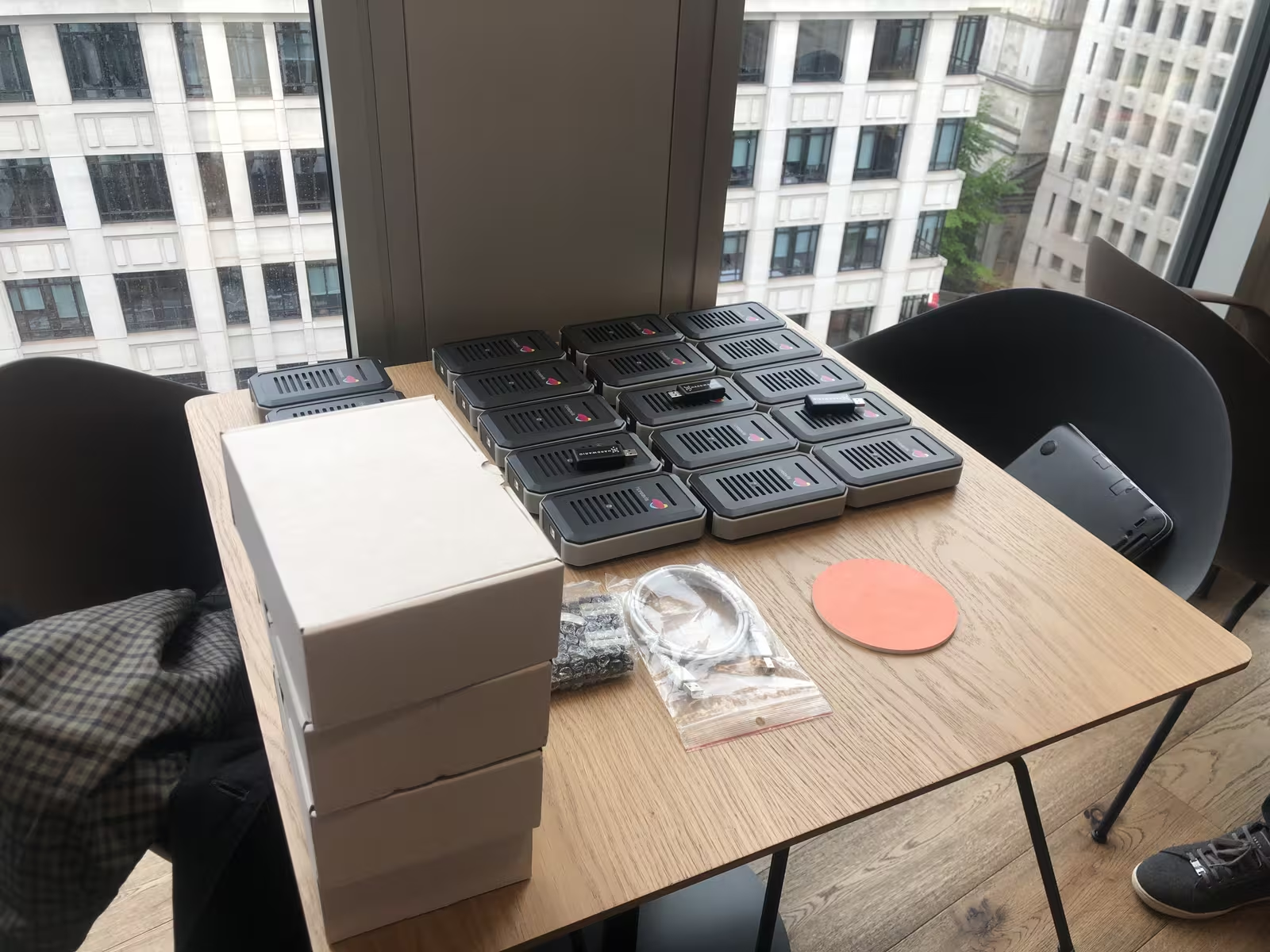
We enclosed the finished devices in industrial housings with the customer’s logo, adapted to optimize the flow of ambient air across the sensors. The developer mounts the device on the wall of each office, where it senses the required values and sends data by radio to a central cloud.
Users see the current CO₂ and other values on monitors connected to the IoT system, and based on the device data the system itself adjusts air conditioning, windows, blinds, and other equipment to keep working conditions ideal.
A low-power design and optimized firmware mean the device runs for roughly two years on three AA alkaline batteries. After that, staff simply buy new batteries anywhere and swap them in, folding the change into routine maintenance.
Results
We first deployed the devices at HB REAVIS’s Bratislava headquarters. Developers mounted the discreet logo-branded boxes on the walls of every office and experienced firsthand what employees of their future projects can expect. They were delighted with the results and went on to equip the office building of their English branch in London’s City.
The devices not only create ideal working conditions - helping employees feel good, avoid health problems, and raise their performance - they also make life easier for facility staff. Thanks to the IoT cloud connection, staff no longer have to react to excess CO₂ themselves; the smart office adjusts the conditions on its own.
By tracking indoor-environment data long term, users can optimize internal technology, work processes, and the building standards of future projects, while significantly cutting building operating costs. Long-term measurement of indoor air quality (CO₂) is also a mandatory condition for obtaining environmentally friendly building certificates - making the devices valuable not only for current occupants of HB REAVIS buildings but for the developers and their future projects.
“A partial custom delivery of multisensors from HARDWARIO fit into our ecosystem at HB REAVIS as a reliable data source built on low-power wireless infrastructure. We rely on it for monitoring, evaluating, and optimizing indoor environmental quality. We look forward to the next iteration!”
HB REAVIS
Related Products
Related Articles

HARDWARIO and DeltaVue: Satellite monitoring of infrastructure from Arctic roads to Brazilian mines

HARDWARIO and Statotest: Smarter Infrastructure Monitoring with IoT Technologies
